
How Do Bulk Cement Tankers Master Efficient Cement Logistics?
ZW Group| 2025-12-4
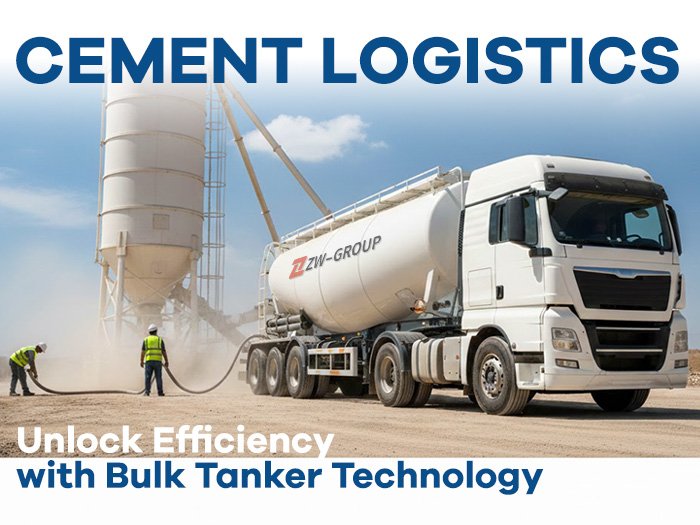
Bulk cement tanker trailers are the definitive standard for construction material transportation. Furthermore, they are crucial for large-scale projects demanding material consistency and streamlined efficiency. Bulk transport fundamentally reduces manual handling and significantly lowers labor costs. In addition, it minimizes product loss during transit. As a result, this translates to faster operational turnover and predictable, reliable delivery schedules for materials suppliers and high-volume contractors.
Technically, the design of modern cement tankers emphasizes smooth internal walls, optimized cone angles, and reliable aeration systems. When the tank is charged with pressurized air, the cement powder behaves like a fluid. Consequently, this allows for rapid and controlled unloading directly into receiving silos via pipelines. Crucially, this clean, closed-loop process virtually eliminates dust pollution and prevents moisture contamination. These are critical operational challenges inherent in traditional bagged delivery.
Understanding the Technical Efficiency
The speed and reliability of unloading are governed by precision-engineered components. This includes the air compressor and the aeration system. Quality tankers utilize powerful, efficient air blowers to fluidize the cement rapidly. These are often designed for high-pressure delivery. The placement and angle of the internal air pipes are essential. Specifically, they must prevent ‘rat-holing’ (cement compacting above the outlet) and ensure complete discharge. Moreover, the selection of wear-resistant pipelines and effective check valves is vital. This prevents backflow and maintains operational integrity during the demanding high-pressure unloading cycle. Proper maintenance of the air filter and blower unit directly contributes to the tanker’s long-term unloading efficiency.
Economic Advantage and Long-Term ROI
While the initial investment in a specialized bulk cement tanker is higher than standard flatbed options, the long-term Return on Investment (ROI) is substantial.
Eliminating Indirect Costs
A single 30–60 m³ tanker can replace the logistical complexity of thousands of individual cement bags. This shift not only eliminates packaging expenses but also removes costs associated with on-site storage losses, disposal of packaging waste, and theft prevention. The reduced reliance on manual labor for unloading further streamlines site operations and enhances worker safety.
Maximizing Project Continuity
For ready-mix plants, infrastructure development (roads and bridges), and commercial projects, the continuous, high-volume supply provided by bulk transport is invaluable. It keeps materials fresh, significantly improves batching accuracy at the plant, and most importantly, supports continuous concrete production with fewer costly interruptions caused by delayed bagged deliveries or material shortages. These efficiencies are crucial for meeting stringent international quality standards in modern construction.
Strategic Conclusion
As construction demand continues to surge across Asia, Africa, and the Middle East, the shift toward bulk cement logistics is accelerating rapidly. Companies that adopt tanker-based supply systems gain superior efficiency, cleaner operations, and robust long-term cost savings. Ultimately, bulk cement tankers are not just equipment; they are a strategic asset for maintaining a modern, competitive, and highly efficient construction supply chain. For a full technical breakdown, consult our definitive guide.
Contact Us for Custom Solutions
Contact our sales team for cement bulk tanker trailer quotations, customization options, and competitive shipping plans tailored to your specific African market needs.
Email: inquiry@zwgroup-vehicle.com
WhatsApp: +86-156-5031-7860
Website Inquiry Form: Available on every product page